Master’s thesis: Restoration and collaborative governance
How can forest companies and environmental organizations—often seen as standing on opposite sides of environmental debates—successfully collaborate on peatland restoration?
Essi Arminen, who works as a junior specialist at Akordi, researched this question in her master’s thesis of environmental policy “Restoration as collaborative governance: from confrontation to resolving common interests in collaborative projects between forest companies and environmental organizations”, completed at the University of Eastern Finland in 2025.
By examining two restoration cases in North Karelia, the thesis aims to understand 1) what collaborative restoration projects between environmental organizations and forest companies look like and what opportunities do they create, and 2) how do actors define their roles in restoration projects and, more broadly, in the field of restoration.
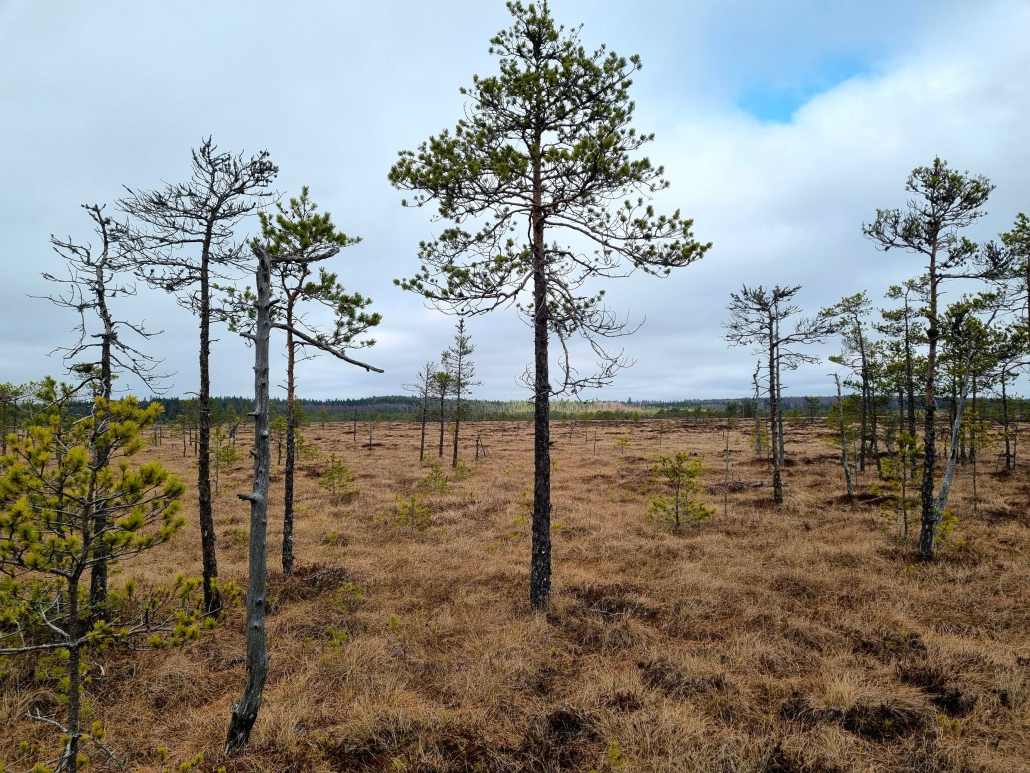
The thesis focuses on two restoration cases of drained peatlands owned by forest companies:
- A 200‑hectare project between UPM and the NGO Luontokollektiivi in Tohmajärvi
- Tornator and SnowChange Cooperative’s multi-site collaboration in the Koitajoki area
Key Findings
Power of shared goals. Despite different institutional and value backgrounds, all actors emphasized biodiversity, climate benefits, and especially improving the condition of water bodies as core reasons for engaging in restoration. The interviewees saw that the actors within the projects had a common goal or interest. Both also had their own goals, such as local solutions or business perspectives.
Collaboration grounded in mutual need. In both cases, the initiative came from ENGOs seeking large, ecologically meaningful restoration sites. Forest companies, in turn, provided land areas essential for achieving impact. Collaboration in its simplicity could be summarized so that both parties need each other to achieve their goals.
Recognition, trust, and learning. The expertise of environmental organizations in restoration was particularly highlighted and their work has earned trust in forest companies and funding authority. Interviewees described cooperation as a process of mutual learning, which is an example of how collaboration can also build social capital in the field of restoration.
Complex views on responsibility. ENGOs saw restoration responsibilities should lie primarily with the actors that caused environmental harm, including the state and large companies. Companies, meanwhile, emphasized fairness and the role of landowners and the importance of ensuring forestry profitability. Both groups, however, agreed that large-scale restoration requires significant public-sector support, especially as national obligations grow under the EU Nature Restoration Regulation.
What these cases tell us about collaborative governance in peatland restoration
The collaborations appeared successful in many ways. The actors succeeded in starting to restore relatively large-scale entities, which could have significant benefits, especially for local water bodies. In these cases we can see new kind’s of collaboration where common interests in biodiversity, climate and water bodies have brought actors from different backgrounds together.
The results show that actors traditionally perceived as opposing actors in environmental policy can implement successful cooperation in natural resource management when the projects serve both parties’ goals and the objectives are shared. Successful cooperation appears to be based on trust in shared views on restoration, knowledge exchange, recognition of expertise, and negotiation.
The projects studied represent processes of collaborative governance, offering valuable insights for advancing restoration efforts.
The study shows that collaboration is not just possible, but it might be essential for meeting national restoration targets and addressing biodiversity loss and climate change. The central question moving forward is how to support, scale, and institutionalize these forms of collaborations so that successful partnerships become the norm rather than the exception.
The thesis can be read here! (in Finnish)

Author:
Essi Arminen, Junior Specialist, Akordi Oy
essi@akordi.fi