Developing interaction between Luke and the large carnivore observers to improve the quality and coverage of large predator observation data
In the spring, Natural Resources Institute Finland (Luke) launched a project supported by the Finnish Wildlife Agency and funded by the Ministry of Agriculture and Forestry, which surveyed the opinions of large carnivore observers on how to develop their activities, increase their significance, and improve interaction between Luke and the observers.
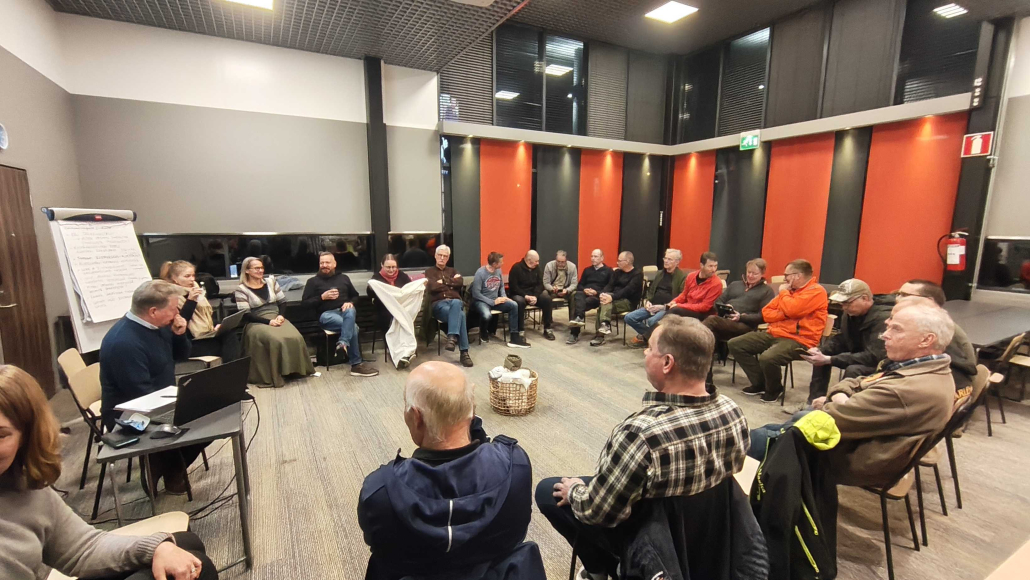
During the project, a number of large carnivore observers were interviewed, and based on these interviews, discussions were held in four workshops organized in different parts of the country, where development ideas, needs, and opportunities were considered together. A total of more than 70 large carnivore observers, Luke’s large carnivore researchers, and experts from the Finnish Wildlife Agency participated in the workshops.
Akordi was responsible for the initial survey interviews, the implementation of the workshops, and the preparation of recommendations for action as an independent party. In early December, we presented a summary of the workshop discussions and recommendations for action in an open webinar for all large carnivore observers. Based on the webinar, we received about ten pieces of feedback from the observers.
Akordi’s recommendations for action
The motivation of large carnivore observers is particularly challenged in situations where there are significant conflicts between their own observations and assessments. It is essential to identify the reasons behind these experiences in order to maintain trust between large carnivore observers and researchers. To address this issue and find a common understanding, we propose two regional pilot projects in which local large carnivore observers and possibly other actors would work together to investigate the possible causes and explanations for the phenomenon, develop practical methods for collecting observations during a single season, evaluate the results together, and draw conclusions for wider distribution. One pilot project would focus on wolf sightings and the other on bears.
The results of the lynx population estimate and the correspondence between the results and the observations were also discussed in the workshops. However, less attention has been paid to the fact that the population assessment method has already been developed and related research is ongoing. With regard to lynx, we propose extensive and active communication on population assessment methods and related research and development work.
One key motive for the activities of large carnivore observers is an interest in large predators and their behavior, and the continuous learning and increasing understanding that this entails. We propose a set of measures through which Luke and the Finnish Wildlife Agency can support the motivation of large carnivore observers and offer compensation for their voluntary work. Such measures could include direct communication with large carnivore observers about current research and its results, changes in the predator situation, the secrets of collecting observations, and the behavior of large predators. Supporting continuous learning could also improve the quality of the observation data.
In addition to information content, large carnivore observers wanted illustrative material that they could use to share information within their own communities. Sharing the results of population assessments with large carnivore observers before they are published in the media would also help them respond to questions they receive when the assessments are published.
The workshops showed that joint meetings between large carnivore observers, the Finnish Wildlife Agency, and Luke worked well in identifying development needs. Based on this experience, we propose an operating model in which the regional offices of the Finnish Wildlife Agency would form “core groups” of the most active large carnivore observers in their areas, in which similar discussions would continue to be held and through which various development needs would be communicated not only to the Wildlife Agency but also to Luke.
In addition, the workshops highlighted a possible “master-apprentice” model for large carnivore observers, in which qualified veterans could guide novice large carnivore observers and coordinate observations in their area. This would distribute the workload more evenly and support the commitment of new large carnivore observers to the activity.
We would like to thank everyone who participated in the work – cooperation will lead to more meaningful large carnivore observers activities!
You can read more about the project and Akordi’s proposals in the Metsästäjä magazine article (in Finnish): 10 ehdotusta petoyhdyshenkilöiden ja Luken yhteistyön edistämiseen (pages 9 and 40-41).